


Incontinence Meaning: Complete Glossary of Terms (2026)

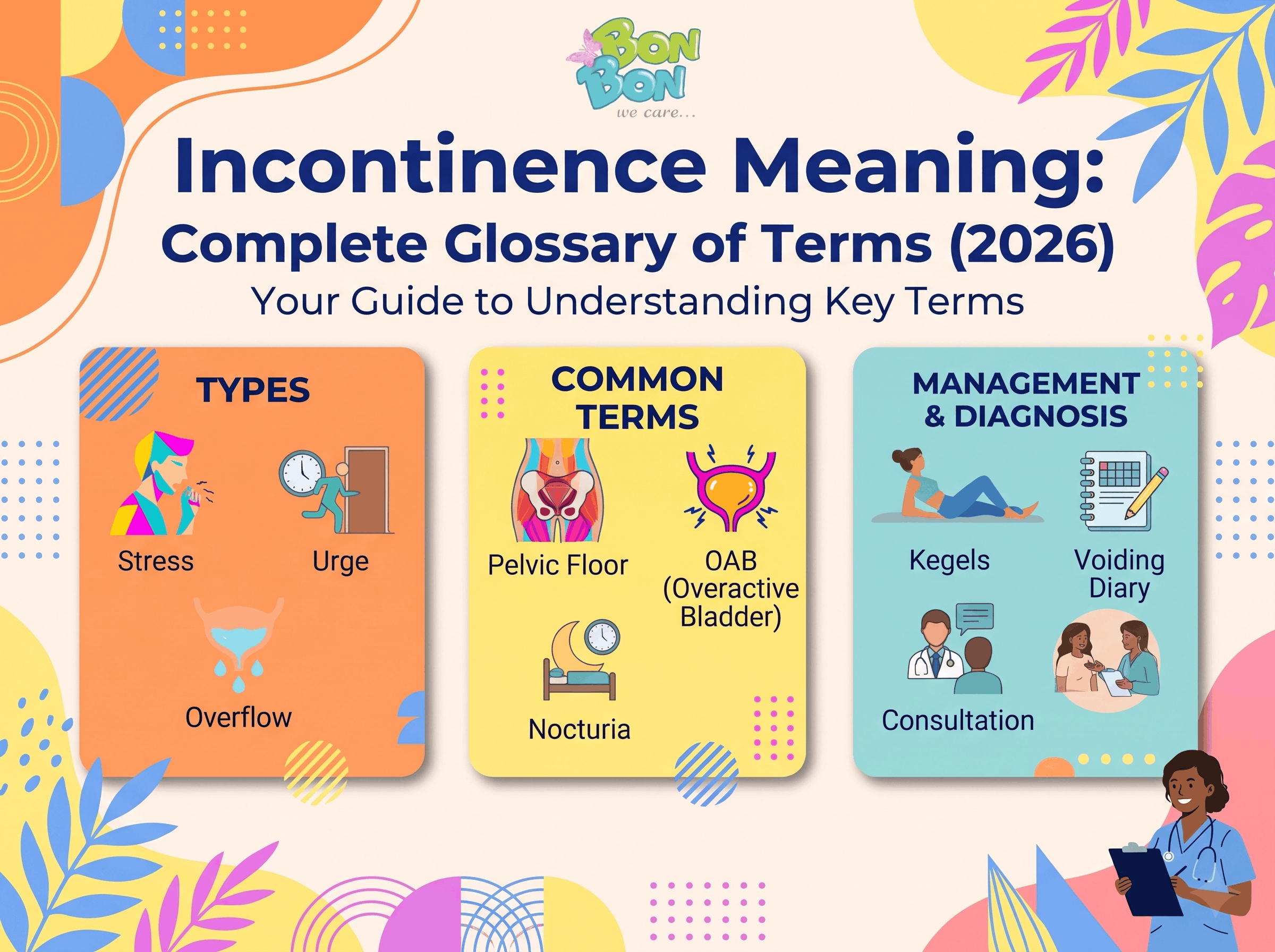
What it is: Incontinence means the involuntary loss of urine or faeces — a loss of bladder or bowel control. It is a symptom, not a disease.
Common types: Stress, urge, overflow, mixed, functional, and reflex incontinence. For skin complications, see incontinence-associated dermatitis (IAD).
What to do: Identify the type, see a doctor for persistent symptoms, and choose the right absorbent product for your level. Browse our pant & tape style diapers.
Good news: Most incontinence is treatable and manageable with the right products and care routine.
Incontinence is the medical term for the inability to control urination or defecation. It affects millions of people in India — men, women, and older adults — and is one of the most common yet least discussed health concerns.
This glossary explains every related term in plain English, so you can understand exactly what a diagnosis, label, or product description means. If you already know the type you’re dealing with, jump to our complete guide to the best diapers for adults.
General Meanings
Incontinence meaning
The involuntary loss of urine or faeces. In medical terms, it is the inability to control bladder or bowel function. It affects people of all ages but is most common in older adults, postpartum women, and people with mobility or neurological conditions.
Incontinence definition
Medically defined as any involuntary leakage of urine or stool. The definition covers a spectrum — from occasional dribbling to complete loss of control — and is classified by type (stress, urge, overflow, functional, mixed).
Incontinence medical definition
In clinical terms: “the complaint of any involuntary leakage of urine” (International Continence Society). For bowel: “the involuntary loss of liquid or solid stool.” Both are symptoms, not diseases.
Continence meaning
The opposite of incontinence — the ability to voluntarily control bladder and bowel function. “Maintaining continence” means preserving that control through lifestyle, pelvic floor exercises, or medical treatment.
Incontinent person meaning
A person who experiences involuntary leakage of urine or faeces. The term describes the symptom, not the person’s identity — many people with incontinence lead fully active lives with the right management.
Types of Incontinence
Stress incontinence meaning
Leakage caused by physical pressure on the bladder — coughing, sneezing, laughing, lifting, or exercise. Most common in women after childbirth and in men after prostate surgery. Caused by weakened pelvic floor muscles or a weakened urethral sphincter.
Urge incontinence meaning
A sudden, intense urge to urinate followed by involuntary leakage before reaching the toilet. Often called an “overactive bladder.” Caused by bladder muscle overactivity or nerve damage.
Overflow incontinence meaning
When the bladder does not empty fully, causing frequent dribbling or a constant sense of fullness. Common in men with an enlarged prostate and in people with nerve damage or weak bladder muscles.
Mixed incontinence meaning
A combination of stress and urge incontinence — leakage both from physical pressure and from sudden urgency. Common in older women and often requires a combined treatment approach.
Functional incontinence meaning
Leakage caused not by bladder problems but by physical or cognitive barriers to reaching the toilet in time — mobility limitations, arthritis, dementia, or an unfamiliar environment.
Reflex incontinence meaning
Involuntary leakage caused by involuntary bladder contractions, often due to spinal cord injury or neurological damage. The person has no sensation of needing to urinate.
Double incontinence meaning
Loss of control over both bladder and bowel. More common in older adults, people with advanced neurological conditions, or those with severe mobility limitations.
Symptoms & Plain-English Terms
Leaky bladder meaning
An informal term for any involuntary urine leakage. It is not a medical diagnosis — it is a description of the symptom that may point to stress, urge, or overflow incontinence.
Dribbling of urine meaning
Small amounts of urine leaking continuously or after urination. Common in men with prostate enlargement (post-void dribbling) and in overflow incontinence. See a doctor if it persists.
Loss of bladder control meaning
The inability to hold urine until reaching a toilet. Can be temporary (infection, medication) or chronic (nerve damage, pelvic floor weakness). Often treatable with exercises, medication, or absorbent products.
Pee in sleep meaning
Involuntary urination during sleep (nocturnal enuresis). Common in children, but also affects adults — often due to deep sleep, bladder overactivity, or medication. For product options, see our guide to nighttime adult diapers for better sleep.
Bowel & Faecal Terms
Bowel incontinence meaning
The involuntary loss of liquid or solid stool. Also called faecal incontinence. Causes include diarrhoea, constipation, nerve damage, muscle damage (childbirth), and surgery.
Faecal incontinence definition
The medical term for bowel incontinence — any involuntary passage of stool. It affects roughly 1 in 10 adults at some point and is more common in older adults and women after childbirth.
Stool leakage meaning
Small amounts of stool leaking involuntarily, often after a bowel movement. Common in people with weakened anal sphincter muscles or chronic constipation.
Regional Meanings (Hindi, Malayalam, Bengali & More)
Incontinence meaning in Hindi
In Hindi, incontinence is commonly described as मूत्र असंयम (mootra asanyam) for urinary incontinence, and मल असंयम (mal asanyam) for bowel incontinence. “असंयम” (asanyam) means “lack of control.”
Incontinence meaning in Malayalam
In Malayalam, urinary incontinence is often described as മൂത്ര അസംയമനം (mootra asamyamanam) — the inability to control urination.
Incontinence meaning in Bengali
In Bengali, it is commonly described as মূত্র অসংযম (mutra asanyam) for urinary incontinence — loss of bladder control.
Incontinence meaning in Telugu
In Telugu, urinary incontinence is described as మూత్ర అసంయమనం (mootra asamyamanam) — the inability to hold urine.
Incontinence meaning in Marathi
In Marathi, it is commonly described as मूत्र असंयम (mutra asanyam) — loss of bladder control.
Product & Care Terms
Incontinence pad meaning
A small absorbent pad worn inside regular underwear for light to moderate leakage. Lighter and more discreet than a full diaper, but not suitable for heavy incontinence or overnight use. If skin irritation develops, see our guide to incontinence-associated dermatitis (IAD).
Continence care meaning
The overall management of incontinence — including absorbent products, skin care, pelvic floor exercises, bladder training, and medical treatment.
Incontinence aids meaning
Products that help manage incontinence: adult diapers, pads, underpads, barrier creams, bed protectors, and odour-control products. For women, see our adult diapers for women; for men, see adult diapers for men.
What to Do Next
Understanding the meaning is the first step. The next step is choosing the right protection and care routine. Our complete guide covers absorbency, sizing, pant vs tape style, cost per use, and a neutral brand comparison for India.
Read: Best Diapers for Adults — Complete 2026 Guide
If you notice blood in urine, sudden changes in bladder or bowel control, or persistent leakage, see a doctor — these can signal an underlying condition that needs treatment. For caregivers managing bedridden patients, see our guide to changing diapers for bedridden patients.
Frequently Asked Questions
Q: What does incontinence mean in simple words?
A: It means you cannot control when you pass urine or stool. It is a symptom, not a disease, and it is very common.
Q: Is incontinence permanent?
A: Not always. Many types improve with pelvic floor exercises, bladder training, medication, or surgery. Others are managed with absorbent products.
Q: What is the difference between stress and urge incontinence?
A: Stress incontinence leaks when you cough, sneeze, or lift. Urge incontinence leaks after a sudden, strong need to urinate. Many people have both (mixed incontinence).
Q: Does incontinence only affect older people?
A: No. It affects young adults, postpartum women, athletes, and people with certain medical conditions. Age is only one risk factor.
Q: When should I see a doctor for incontinence?
A: See a doctor if leakage affects your daily life, if you notice blood, if it starts suddenly, or if it doesn’t improve with home management.
Q: What size adult diaper do I need?
A: It depends on waist/hip measurement, not clothing size. Browse our size ranges: Small (S), Medium (M), Large (L), XL, and XXL.
Need Help Choosing the Right Adult Diaper?
BonBon offers breathable, high-absorbency diapers designed for Indian needs. Free delivery across India. Learn more about us.
🛒 Shop Adult Diapers 💬 Ask on WhatsApp